Research 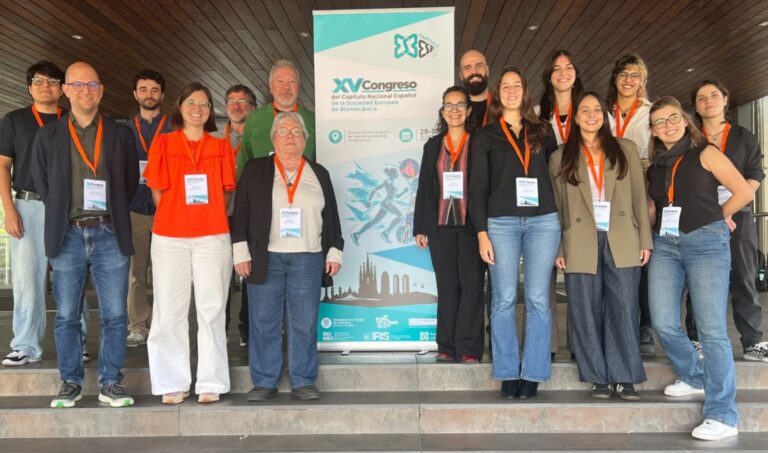
November 2, 2026



Artificial intelligence is no longer a promise for the future of medicine. It is already present in hospitals, research laboratories and young companies, and the real question today is how to bring it into clinical practice in a way that is useful, reliable and fair. This was the common thread of the II Annual Meeting of the Spanish Society of Artificial Intelligence in Biomedicine (IABiomed), held on 30 October at the Casa de Convalescència of the Hospital de la Santa Creu i Sant Pau, in Barcelona.
IABiomed was officially founded in December 2022 to promote research, development and knowledge transfer of AI in biomedicine, and to bring this field closer to society and to the scientific and industrial community. After its first workshop and annual meeting in Madrid in 2024, its first congress in Seville in 2025 and its first Biomedicine Hackathon earlier this year, the society chose Barcelona to close 2026 with a full day of dialogue between the three worlds that need to work together for AI to reach patients: entrepreneurs, clinicians and academics.
The programme was organised precisely around these three perspectives. The morning opened with a session on entrepreneurship and innovation, in which startups and companies presented real use cases in early cancer detection, sepsis alert or medical imaging in short Pechakucha format, sharing what it really takes to scale a solution, validate it clinically and reach the market. The second session gave the floor to professionals from Sant Pau, Bellvitge, Vall d’Hebron and Sant Joan de Déu, who offered an honest view of what AI brings to their daily work, but also of its limitations, the barriers to adoption and the needs that remain unmet.
The afternoon session, devoted to learning with AI, focused on the role of universities as engines of research, training and talent. It was here that Clara Prats, researcher at the Institute for Research and Innovation in Health (IRIS) and the BIOCOM-SC group of the Universitat Politècnica de Catalunya, opened the session with a talk on AI and biomedical research in a technological university. Her contribution placed the focus on a key idea for IRIS: innovation in health must be ethical and responsible from the very beginning, and a technological university is in a privileged position to make this happen, connecting engineering, data and clinical knowledge with the real needs of the health system.
She shared the stage with colleagues from Universitat Rovira i Virgili, Universitat de Barcelona, Universitat Pompeu Fabra and UPC, who addressed topics such as explainable AI for more reliable diagnosis, digital biomarkers in biomedical signals and the potential of quantum computing for health. The session ended with a round table moderated by Antoni Pérez Navarro, from the Universitat Oberta de Catalunya, and the day closed with the David Riaño awards and the prizes of the 2026 Hackathon.
For IRIS UPC, being part of meetings like this one is a natural way of fulfilling its mission. As an institute that brings together research groups working at the intersection of engineering and health, IRIS believes that the impact of AI will depend not only on better algorithms, but also on trust, collaboration and the ability to build bridges between university, hospitals and companies. Conferences such as the IABiomed Annual Meeting are exactly the kind of meeting point where these bridges begin.