News 
July 28, 2026


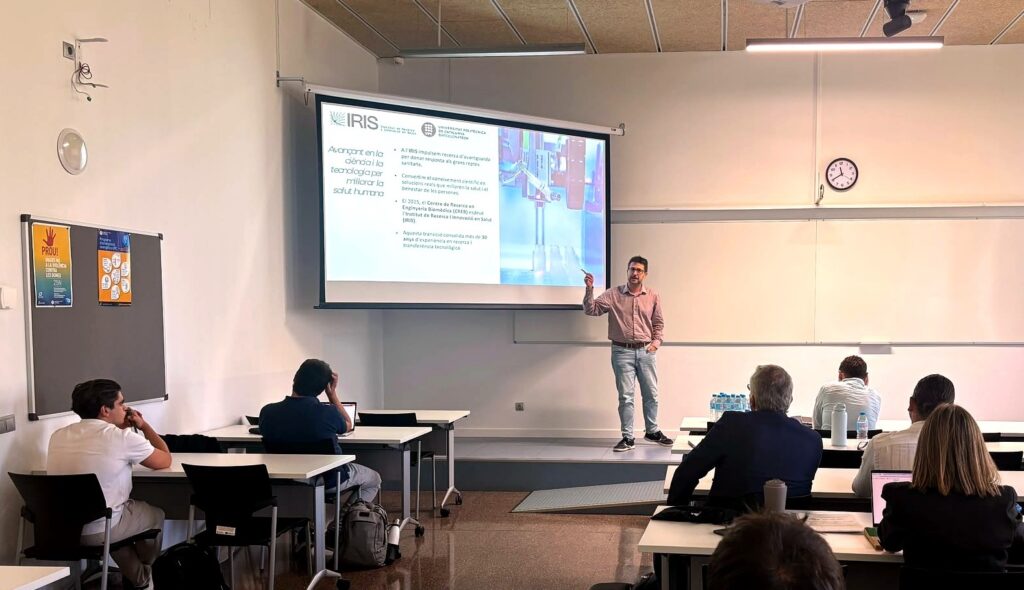
On Tuesday 15 September, IRIS took part in “La recerca aplicada. La força de la indústria” (“Applied research. The strength of industry”), a joint conference organised by the Universitat Politècnica de Catalunya (UPC) and BCN Medicare Industrial Hub. Held at the EEBE campus in Diagonal-Besòs and streamed online, the session brought together eleven UPC research groups working at technology readiness level 5 (TRL5) with representatives of Catalonia’s medical device manufacturing industry.
Carles Mas represented IRIS, presenting the institute’s work in interdisciplinary biomedical engineering research to an audience of industry partners and fellow researchers. His talk placed IRIS alongside ten other groups spanning the full breadth of health technology: mathematical models for breast cancer detection (MAPTHE), drug stability and crystallisation (GCM), AI-based diagnostics for smart medical devices (CoDAlab), biomaterials and tissue engineering (BBT), biodegradable polymers for controlled drug release (PSEP), multiscale simulation of biological flows (CoPhyBiM), low-power biomedical sensors (IEB/EPIC), photonics and optical engineering for diagnosis (CD6), sensors for digital health (ISI) and robotics and computer vision for surgical assistance (IRI).
The event opened with a presentation from CIT-UPC, the university’s technology transfer office, which explained how it connects companies with UPC research groups and helps them access public R&D funding through programmes such as CDTI, ACCIÓ and Horizon Europe. BCN Medicare Industrial Hub then introduced its own model: a consortium of nine Catalan manufacturers — covering everything from product design and electronics to injection moulding, precision machining and regulatory consulting — that together offer a single point of contact for the entire lifecycle of a medical device, from concept to post-market support. The hub, certified to ISO 13485, brings together more than 250 workers across 14,000 m² of facilities.
That pairing set the tone for the morning: each research group’s TRL5 results were presented not as academic outputs, but as technology ready to be picked up by industry. It is precisely the kind of bridge IRIS works to build — taking interdisciplinary biomedical engineering research out of the lab and into real medical devices and clinical applications.
The session closed with a visit to the Centre Multiescala, led by Prof. Josep Lluís Tamarit, giving attendees a first-hand look at some of the infrastructure behind this research-to-industry pipeline.
By taking part, IRIS reinforced its role as a reference point for interdisciplinary biomedical engineering research within UPC, and strengthened its ties with the industrial partners who can turn that research into products that reach patients.