Research 
October 8, 2026


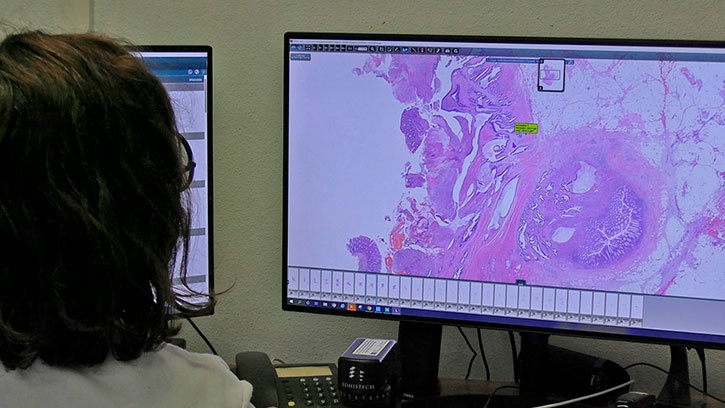
When a pathologist examined a tissue sample under the microscope, much of the work used to depend on counting by hand a small number of cells that react to immunohistochemical stains, the techniques that reveal the presence of cancer. DigiPatICS has changed that routine across Catalonia’s public health system. Coordinated by the Institut Català de la Salut (ICS), with the Image Processing Group (GPI), one of the research groups of IRIS UPC, as its technological partner, the project combines the digitisation of histopathological samples with artificial intelligence tools that analyse them automatically. The result is a faster, more precise and more reliable diagnosis for patients.
The project began in 2020 with support from the Catalonia ERDF Operational Programme and in partnership with Palex Medical. Its first phase focused on digitisation: since 2022, ICS hospitals have worked with 24 high precision scanners connected to 13 workstations, building a shared database of more than four million digitised images. Pathologists can now examine far more cells per sample and share both images and diagnoses securely and in real time with colleagues in other hospitals.
On top of this infrastructure, the GPI team developed the intelligence. “We have created artificial intelligence algorithms based on deep learning that automatically detect, quantify and classify the cells that react to immunohistochemical stains,” explains Ferran Marqués, GPI researcher, professor at the UPC School of Telecommunications Engineering of Barcelona (ETSETB) and head of the project. “The process is not only faster. Statistical precision improves and diagnoses become reproducible, which is one of the main goals of DigiPatICS.” The first four algorithms analyse the stains used in breast cancer for the HER2 and Ki67 proteins and for oestrogen and progesterone receptors. In 2024, barely a year after they were introduced, they had already analysed 13,885 images and supported the treatment of more than 4,400 patients.
The results are available to more than 170 pathologists in seven ICS hospitals: Arnau de Vilanova in Lleida, Bellvitge in L’Hospitalet de Llobregat, Germans Trias i Pujol in Badalona, Doctor Josep Trueta in Girona, Joan XXIII in Tarragona, Vall d’Hebron in Barcelona and Verge de la Cinta in Tortosa. Images and diagnoses are also shared with the Hospital de Viladecans, completing the ICS network. Connected in this way, pathologists can review cases together and issue diagnoses remotely, in what is now one of the largest digital pathology networks in Europe and probably in the world.
Breast cancer was the natural starting point, given that around one in eight women will face the disease at some point in their lives. The project has now entered a second phase, funded directly by the ICS, which is extending the work to other cancers such as lung, colon and endometrial cancer, with continuity foreseen until 2027. For the ICS, the tools have also become a driver of the digital transformation of its pathology services.
The work has already been recognised. In November 2025, DigiPatICS received the 15th UPC Research Valorisation Award, granted by the UPC Board of Trustees with the support of Fractus, in the category of best technology transfer project, for the success of its implementation, the social impact of the transfer and its contribution to the United Nations Sustainable Development Goals.
Alongside Ferran Marqués, the research team includes Josep Ramon Casas, Montse Pardàs, Philippe Salembier and Verónica Vilaplana, all members of the GPI. DigiPatICS is a clear example of the kind of research IRIS UPC exists to promote: engineering knowledge that leaves the laboratory, enters the hospital and changes the daily work of clinicians and the lives of patients.