Research 
November 2, 2026


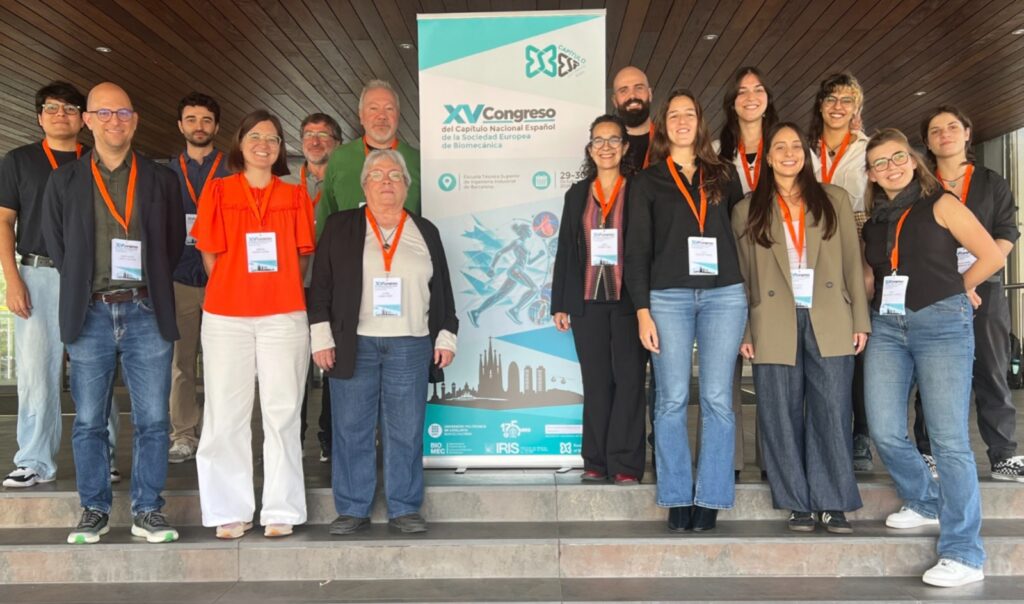
Every step we take, every heartbeat and every movement of a joint can be explained through mechanics. Biomechanics applies the tools of engineering to understand how the human body works, and why it sometimes fails, in order to design better prostheses, more precise surgeries, more effective rehabilitation therapies and safer medical devices. On 29 and 30 October, Barcelona became the meeting point of this discipline in Spain with the XV Congress of the Spanish Chapter of the European Society of Biomechanics (ESB), held at the Escola Tècnica Superior d’Enginyeria Industrial de Barcelona (ETSEIB).
The congress was organised by the BIOMEC Lab of the Universitat Politècnica de Catalunya, the research group led by Josep Maria Font Llagunes, director of IRIS UPC, with an organising committee chaired by Rosa Pàmies Vilà. The Spanish Chapter of the ESB was created in 2011 to connect professionals and researchers in the field, strengthen collaboration between university, clinic and industry, and give visibility to the biomechanics research carried out in Spain. The event was sponsored by the European Society of Biomechanics, the UPC, its Department of Mechanical Engineering and IRIS UPC.
The congress began in the most hands-on way possible. On Thursday morning, participants visited laboratories and saw technology in action, from the activities of the LABORA lab and a live demonstration of the exoskeleton developed by Able Human Motion, to guided visits to the BIOMEC, BIOART and IOC laboratories. In between, IRIS UPC and the XartecSalut network presented their main lines of activity and their initiatives in research and technology transfer in health, an opportunity to show how a technological university can turn engineering knowledge into real impact for patients and the health system.
In the afternoon, the opening ceremony brought together representatives of the UPC, the ETSEIB, the Department of Mechanical Engineering, IRIS UPC and the organising committee. It was followed by the plenary lecture by Laura Marchal-Crespo, from Delft University of Technology, who explained how robotics and virtual reality can be designed to offer rich, meaningful and usable experiences that help people learn movements again after a neurological injury.
Over the two days, parallel sessions covered the whole spectrum of the discipline: tissue mechanobiology, patient-specific cardiovascular modelling, clinical diagnosis, movement analysis, sports biomechanics, robotic rehabilitation and exoskeletons, prostheses and assistive devices, new materials and emerging technologies such as artificial intelligence. Two round tables added a broader view. One presented a university competition in which students design prosthetic hands, showing how a classroom project can become a real technological challenge. The other, devoted to Women in Biomechanics, opened a debate on female visibility and leadership in the field, with the participation of Míriam Febrer Nafría, researcher of BIOMEC. The congress closed with a session of selected works and the awards ceremony.
For IRIS UPC, supporting a congress like this one is much more than a sponsorship. Biomechanics is at the heart of several of our research groups, and meetings where engineers, clinicians and companies sit at the same table are exactly what makes innovation in health move forward. Our congratulations to the BIOMEC team and to everyone who made these two days in Barcelona possible.