News 
October 21, 2026


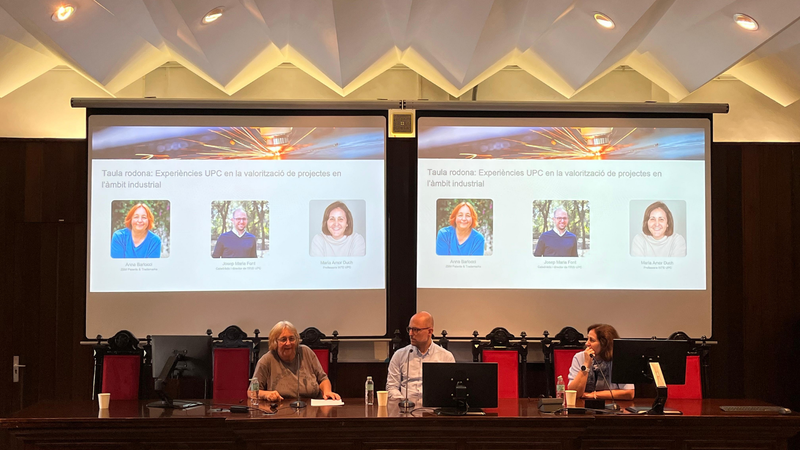
IRIS had a double presence at the Patent Day 2026, held on 8 October at the Barcelona School of Industrial Engineering (ETSEIB) as part of its 175th anniversary. Two of the research groups that make up the institute were invited to the round table on real experiences of turning research results into products and companies: BIOMEC, represented by its head and IRIS director Josep Maria Font, and IONHE, represented by its head Maria Amor Duch, from the Institute of Energy Technologies (INTE).
Font shared the story of Able Human Motion, a spin-off created in 2018 through the transfer of a patented exoskeleton that improves the mobility, health and quality of life of people with disabilities. His account covered the full journey, from the first research in the laboratory to a company that brings the technology to the people who need it.
Duch presented LINpass, a project that is still in its valorisation phase. It builds on two neutron dosimetry technologies developed by her group for industries that use nuclear technology, with a special focus on healthcare, and it aims to become a spin-off in the near future.
The two experiences show different moments of the same path: one technology already on the market through a consolidated company, and another preparing to take that step. Having two IRIS groups on the same panel also reflected the breadth of the institute, from biomechanics to radiation dosimetry, and its shared purpose of turning research into solutions that reach patients, professionals and society. After their talks, the speakers answered questions from an audience of researchers interested in following a similar route.